
Emily Carr University of Art and Design is situated on the unceded, traditional, and ancestral territory of the Coast Salish Peoples, including the territories of the xʷməθkwəy̓əm (Musqueam), Skwxwú7mesh (Squamish), and Səl̓ílwətaʔ/Selilwitulh (Tsleil-Waututh) Nations.
Emily Carr University is committed to providing the necessary support to Aboriginal students to ensure their academic success. The University provides admission and transfer advising services and educational support service resulting in excellent retention and graduation rates for Aboriginal students. We have had a steady increase in our diverse Aboriginal Student population as well as an increase in our Aboriginal programs. The Aboriginal Program Office provides culturally appropriate support that encompasses both traditional and contemporary artistic and cultural expressions of Aboriginal peoples, and is a valuable resource for students to access traditional materials/supplies. The Aboriginal Program team also assists with the promotion and coordination of events and workshops related to Aboriginal art and culture, and provides information regarding Aboriginal funding, scholarships and awards.
Aboriginal Gathering Place
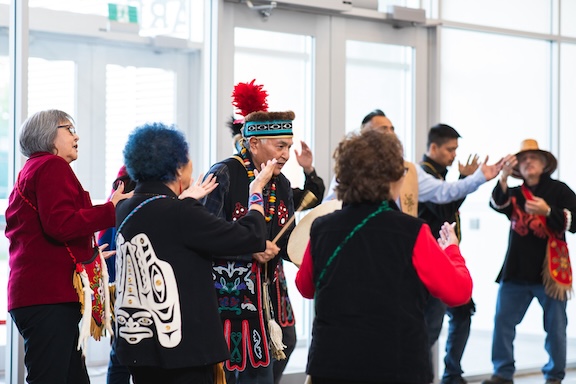
Dempsey Bob along with his family and community members perform the Carver’s Dance at the unveiling of the totem pole, Pacific Song of the Ancestors. (Photo by Hayf Photography)
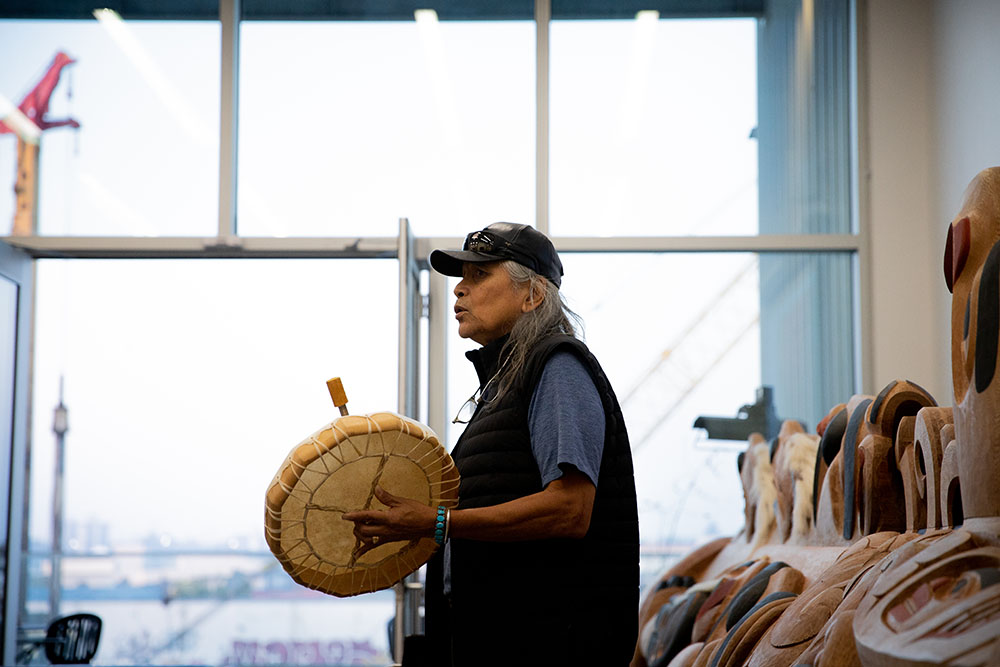
Emily Carr University’s Aboriginal Gathering Place is a centre that reflects the cultural characteristics of our Aboriginal students, community and traditions. This space is dedicated to student projects, workshops, ceremonies and celebrations of the University’s Aboriginal community. The Gathering Place allows our Aboriginal students to develop and strengthen their identities in a supportive, safe environment. The design of the space is relevant to and congruent with Aboriginal philosophies and values.
Who is an Aboriginal Student?
Aboriginal students include students from North America with First Nations (status and non-status), Métis or Inuit backgrounds. Students with Aboriginal ancestry are encouraged to self-identify on their application forms and contact the Aboriginal Program Office. The Aboriginal Gathering Place communicates with Aboriginal students regarding grants, meetings, special events, Aboriginal community resources, and other relevant activities.
Aboriginal Gathering Place Staff
| Kajola Morewood Interim Director, Indigenous Programs kmorewood@ecuad.ca |
Sydney Pascal Manager, Aboriginal Programs spascal@ecuad.ca |
Kimberly Ronning Coordinator, Aboriginal Programs kronning@ecuad.ca |
Kajola Morewood has Inuit ancestry through her birth mother who had ties to Chisasibi and Kuujjuarapik in Nunavik and British ancestry through her birth father. She holds a BFA in Photography from Emily Carr University of Art + Design and a Master of Library and Information Studies (First Nations Curriculum Concentration) from the University of British Columbia. An interdisciplinary artist, she explores issues of cultural re/connection and the ways in which Indigenous knowledge and belongings are held in western cultural institutions.
Sydney Frances Pascal is a member of Lil’wat nation. Her multi-disciplinary practice includes hide tanning, video, sound, beadwork and poetry. She uses her practice to tell her family’s story. Her work over the past few years has been grounded by her continued connection to land-based material practices.
Kimberly Ronning is a member of the Tk’emlúps te Secwépemc Nation and is based in Vancouver. She holds a BFA from Emily Carr University of Art + Design and works primarily in ceramics. Her practice moves between recognizable consumer products and closed-form ceramic sculptures that incorporate moose tufting, horsehair, and sinew. She explores identity, place, and personal histories, while her closed forms play with sound and movement. Kimberly approaches making as a way of building relationships with family, materials, and her own identity.